AI Detectionpublished on Jun 24, 2026
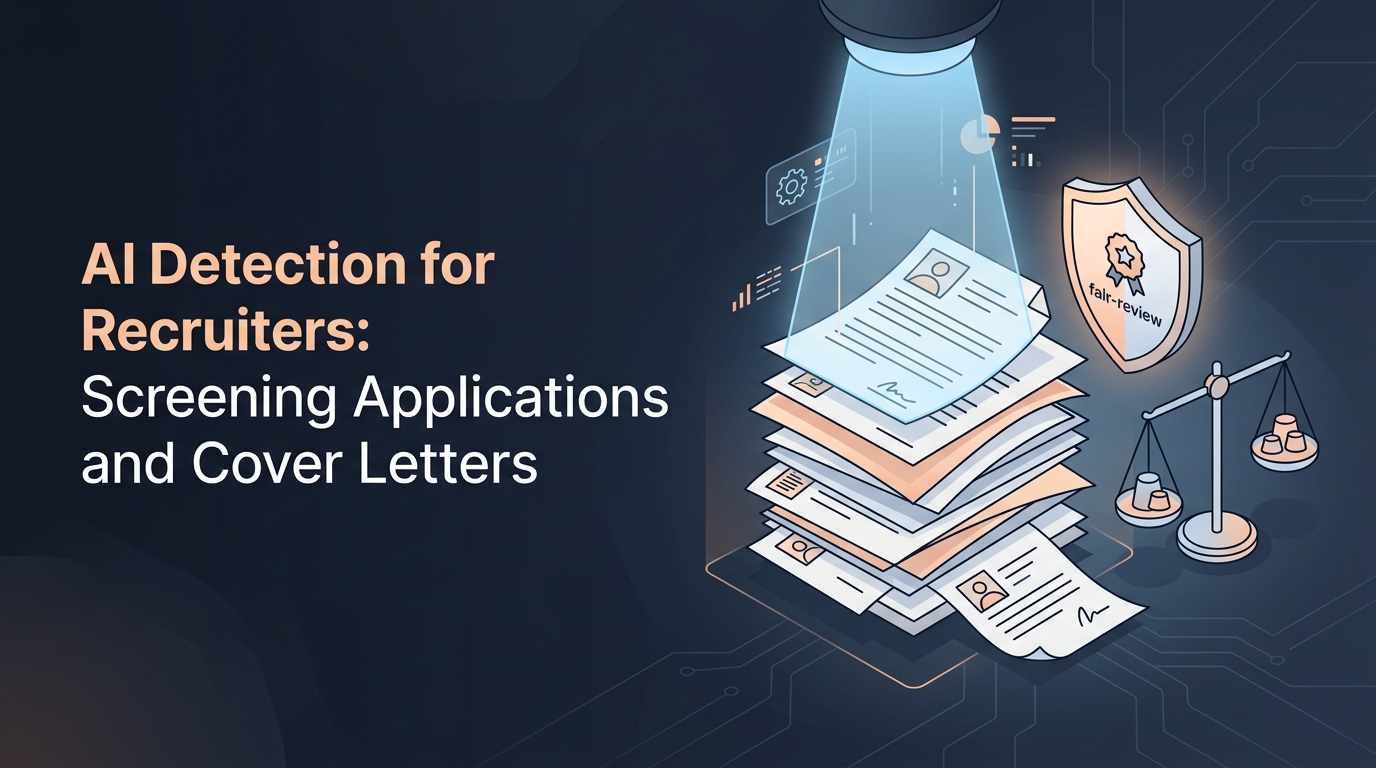
AI Detection for Recruiters: Screening Applications and Cover Letters
AI-assisted writing is now part of how many candidates apply for jobs. Drafting a cover letter with a chatbot, polishing a resume summary, or translating a paragraph into clearer English is common and often reasonable. For recruiters, the goal is not to punish tool use but to understand what an application actually tells you about the person behind it. AI detection can help, as long as scores are read as signals that inform a decision rather than triggers that automatically reject a candidate.
Why AI detection matters in hiring
Recruiters read applications to predict communication, judgment, and fit. A cover letter generated entirely by a model, with no editing or personal context, gives you less signal about the candidate than one they shaped themselves. Detection helps you notice where a closer human read is worth the time. The AI Detector produces a probability and highlights passages, but it does not decide whether a candidate is qualified. That judgment stays with your team.
Set policy before you screen
Candidates deserve to know the rules. Decide in advance whether AI assistance is welcome, discouraged, or required to be disclosed, and state it in the job posting. A clear policy makes screening fairer and easier to defend.
- Allowed and expected: Many roles benefit from candidates who use tools well. Reward the result, not the method.
- Disclosure requested: Ask applicants to note where they used AI, then evaluate honesty alongside content.
- Limited: For writing-heavy roles, you may ask for an unassisted sample so you can assess raw skill directly.
Document the workflow
Record how scores feed into your funnel, who reviews flagged applications, and what a candidate can do if they disagree. A documented process protects both the candidate and the hiring team.
Read the score as a signal, not a verdict
A high AI-likelihood score is a prompt to look more carefully, not proof of dishonesty. Compare the cover letter against the resume, the portfolio, and any later interview answers. Consistency across sources is far more telling than a single number. Reviewing the methodology behind detection helps your team explain what the signal does and does not mean.
Guard against bias and false positives
Detection is imperfect, and the people most likely to be misjudged are often the ones you least want to lose. Non-native English speakers, candidates who write in plain, formulaic styles, and applicants who used a template can all score higher without any wrongdoing. Understanding detector accuracy and its limits is essential before any score influences an outcome. Never auto-reject on a score alone, give candidates a chance to respond, and audit your decisions for patterns that disadvantage particular groups.
A fair screening checklist
Keep your process consistent so every applicant is treated the same way.
- Publish your AI policy in the job description before applications open.
- Use detection only as one input among resume, portfolio, and interview signals.
- Have a human review every flagged application before any rejection.
- Offer candidates a path to clarify or submit an unassisted sample.
- Audit outcomes regularly to catch bias against non-native speakers.
Used this way, AI detection makes screening more informed without making it less humane. The number narrows where you look; your team still decides who to hire.
Frequently Asked Questions
Should we reject candidates whose cover letters score as AI-written?
No. A score is a signal to review more closely, not grounds for automatic rejection. Detection tools produce false positives, and many strong candidates use AI to polish their writing. Pair the score with other evidence before any decision.
Is it fair to screen applications for AI use at all?
It can be, if you are transparent. State your policy in the job posting, apply it consistently, and let candidates respond to concerns. Hidden or inconsistent screening is what creates unfairness, not the tool itself.
Could AI detection discriminate against non-native English speakers?
Yes, it can. Plain, formulaic, or translated writing sometimes scores higher even when no AI was used. This is why you should never rely on a score alone and should audit outcomes for patterns that disadvantage particular groups.
How should detection fit into our hiring funnel?
Treat it as one input alongside the resume, portfolio, and interview. Use it to decide where a human reviewer spends extra attention, document the workflow, and keep a person in the loop for every flagged application.
Share
Related Posts
AI Detection
A fair, factual comparison of how Turnitin and GPTZeroAI approach AI detection, with a focus on workflow, transparency, and evidence reviewers can act on.
Jun 24, 2026
AI Detection
ChatGPT, Claude, and Gemini each leave different writing fingerprints. Here is what actually changes detectability, and why no model is reliably invisible.
Jun 24, 2026
AI Detection
AI detectors can flag human writing by mistake. Learn what drives false positives and how to build a fair, evidence-based review workflow.
Jun 24, 2026