AI Detectionpublished on Jun 24, 2026
ChatGPT vs Claude vs Gemini: Which AI Writing Is Hardest to Detect?
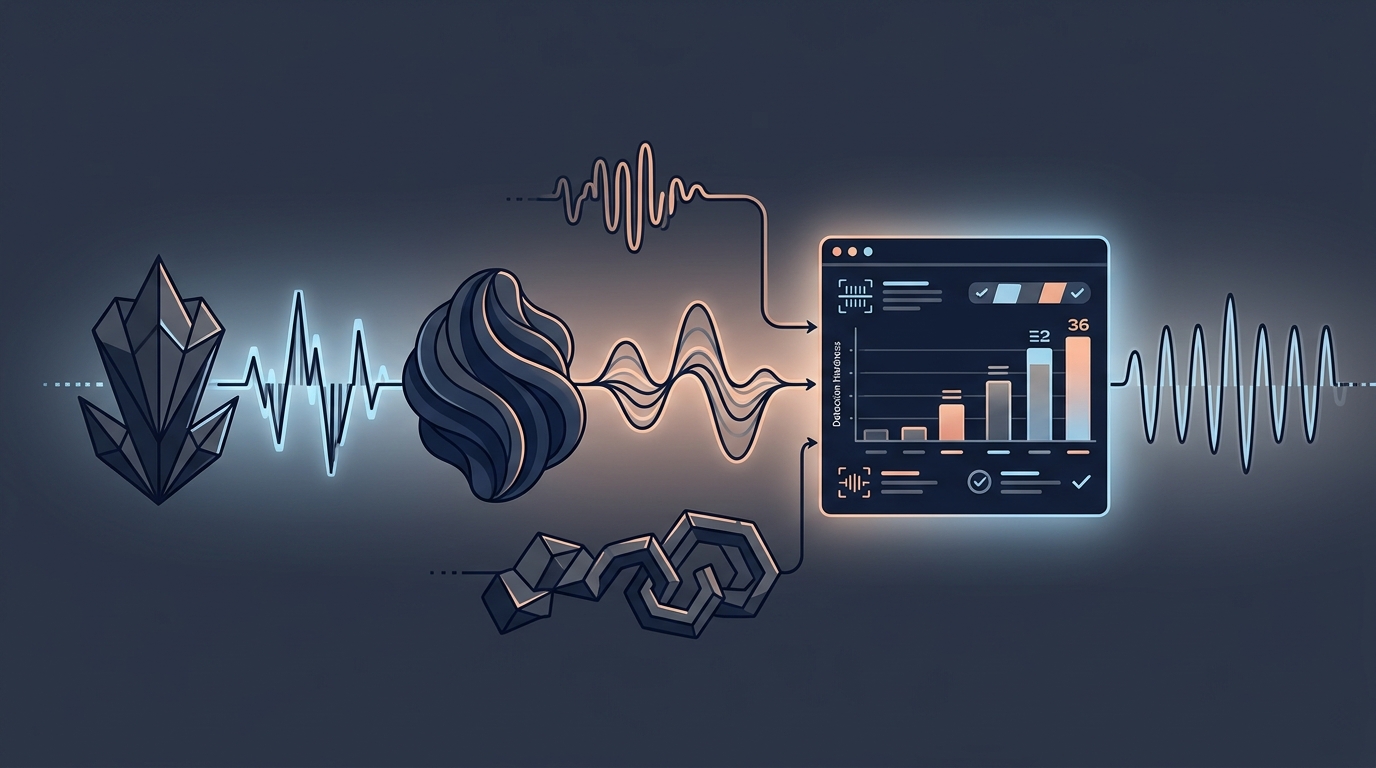
A common question from writers, editors, and educators is simple: which AI model is hardest to detect? The honest answer is that the model name matters less than how the text was generated, edited, and prompted. Still, ChatGPT, Claude, and Gemini do leave somewhat different writing fingerprints, and understanding them helps reviewers read detection results more fairly.
Why model fingerprints exist at all
Large language models are trained on different data, tuned with different objectives, and shaped by different default styles. Those choices surface in measurable patterns: sentence length variation, vocabulary range, transition habits, and how confidently a model hedges. Detection tools like the AI Detector read these statistical signals rather than any hidden watermark, so the question is really about which patterns each model tends to produce.
How the three models tend to differ
None of these are absolute rules, but reviewers often notice broad tendencies.
- ChatGPT (including GPT-4 and GPT-5 variants) often produces balanced, well-structured prose with predictable paragraph rhythm, which can read as smooth but uniform.
- Claude frequently writes in a more conversational, explanatory register with longer reasoning chains and careful hedging.
- Gemini tends toward concise, fact-forward phrasing and list-friendly structure.
These differences mean a single detector threshold can behave differently across models, which is why a Claude detector view or a Gemini detector view can be useful context rather than redundant tools.
What actually changes detectability
In practice, prompting and editing influence detection far more than the model brand. Heavy human revision, mixing sources, translating, and adding personal voice all reduce the uniform patterns detectors rely on. Conversely, long, single-shot generations with default settings tend to be the most detectable, regardless of which model produced them.
Why "hardest to detect" is a moving target
Models are updated frequently. A version that reads as highly uniform today may be tuned for more natural variation next quarter. Treating any model as permanently undetectable is a mistake, and so is assuming a clean score proves human authorship.
Reading results responsibly
Because no model is reliably invisible and none is reliably caught, scores should be treated as review evidence, not verdicts. Compare the signal with document type, drafts, and citations before drawing conclusions. Our methodology explains which signals are weighed and why a percentage is a starting point for inspection rather than an accusation.
The practical takeaway
There is no single model that is always hardest to detect. Detectability depends on generation length, prompting, editing depth, and how recently the model was updated. The most reliable approach is to use detection as one structured input inside a documented review process, applied consistently across ChatGPT, Claude, and Gemini alike.
Frequently Asked Questions
Which AI model is hardest to detect?
There is no permanent answer. Detectability depends more on prompting, length, and editing than on whether the text came from ChatGPT, Claude, or Gemini, and each model is updated often.
Does GPTZeroAI detect all three models?
Yes. GPTZeroAI analyzes statistical writing signals rather than model-specific watermarks, so it evaluates text from ChatGPT, Claude, Gemini, and other systems with the same review-oriented approach.
Can editing make AI writing undetectable?
Substantial human revision can reduce the uniform patterns detectors rely on, which is why scores should always be read alongside drafts and context rather than treated as a final verdict.
Should a low score prove a human wrote it?
No. A low or clean score is not proof of human authorship, just as a high score is not proof of misconduct. Both are evidence to review within a fair, documented workflow.
Share
Related Posts

AI Detection
A fair, factual comparison of how Turnitin and GPTZeroAI approach AI detection, with a focus on workflow, transparency, and evidence reviewers can act on.
Jun 24, 2026
AI Detection
AI-assisted applications are now common. Learn how recruiters can use AI detection as a fair signal in resume and cover letter screening without auto-rejecting candidates.
Jun 24, 2026

AI Detection
AI detectors can flag human writing by mistake. Learn what drives false positives and how to build a fair, evidence-based review workflow.
Jun 24, 2026