
Academic Writingpublished on May 31, 2026
AI Detection Policy Template for Schools and Teams
What an AI detection policy should cover
An AI detection policy should define acceptable AI assistance before a dispute happens. The policy should explain disclosure rules, what evidence may be reviewed, how detector results are interpreted, and how writers can respond.
Schools can pair this template with academic integrity workflows. Teams can adapt it for enterprise AI detection or security and privacy review.
Template sections
Allowed AI use: define whether brainstorming, outlining, grammar review, translation, or drafting is allowed. Disclosure: explain when writers must say how AI helped. Evidence review: list drafts, citations, writing history, and detector results. Follow-up: define revision, clarification, appeal, and escalation paths.
Implementation checklist
Use plain language. Give examples. Train reviewers on false positives. Avoid automatic punishment based on a score. Review the policy each term or quarter as AI tools and expectations change.
FAQ
Who should own the policy?
Ownership depends on context. Schools may involve academic affairs, faculty, student conduct, and accessibility teams. Businesses may involve legal, compliance, editorial, security, and department leaders.
How often should the policy change?
Review the policy on a predictable schedule and after major AI tool changes. Keep the core principles stable while updating examples and workflow details.
Frequently Asked Questions
Can a student be disciplined based only on an AI detector score?
No. A detector score is a signal, not proof, so a fair policy treats it as the start of a conversation rather than a verdict. Combine it with drafts, version history, citations, and a chance for the writer to explain before any action is taken.
How do you handle false positives in an AI detection policy?
Build in a clear review and appeal step so flagged work gets a human read, not an automatic penalty. Train reviewers that non-native speakers and formulaic writing can raise scores, and ask for supporting evidence like drafts or writing history before reaching a conclusion.
What should an AI disclosure statement actually say?
It should name which tools were used and for what, such as grammar checking, outlining, translation, or drafting, in one or two plain sentences. Keeping disclosure short and specific makes it easy for writers to comply and for reviewers to assess.
Does the same policy work for schools and for workplace teams?
The core structure carries over, but the owners and stakes differ, so adapt the details. Schools usually involve academic affairs and student conduct, while teams add legal, compliance, security, and editorial review, each with its own escalation path.
Share
Related Posts

Academic Writing
A practical, fair-minded guide to writing classroom AI policy: treat detector scores as signals, protect due process, and build a review workflow students can trust.
Jun 24, 2026
Academic Writing
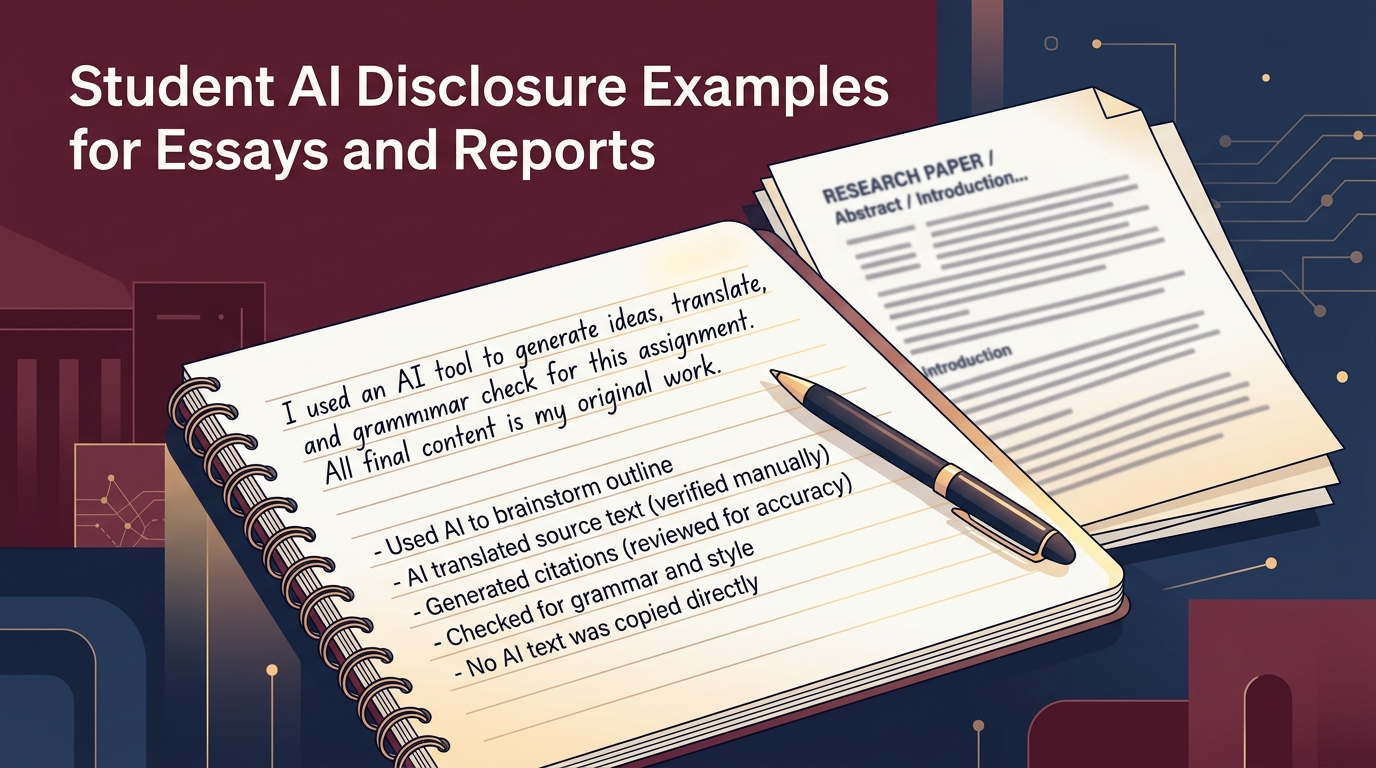
Examples of student AI disclosure statements for brainstorming, outlines, grammar review, translation, citation support, and draft revision.
May 31, 2026
Academic Writing
A practical checklist for universities designing AI detection policies, disclosure rules, review steps, and student-centered appeals.
May 31, 2026