Academic Writingpublished on May 31, 2026
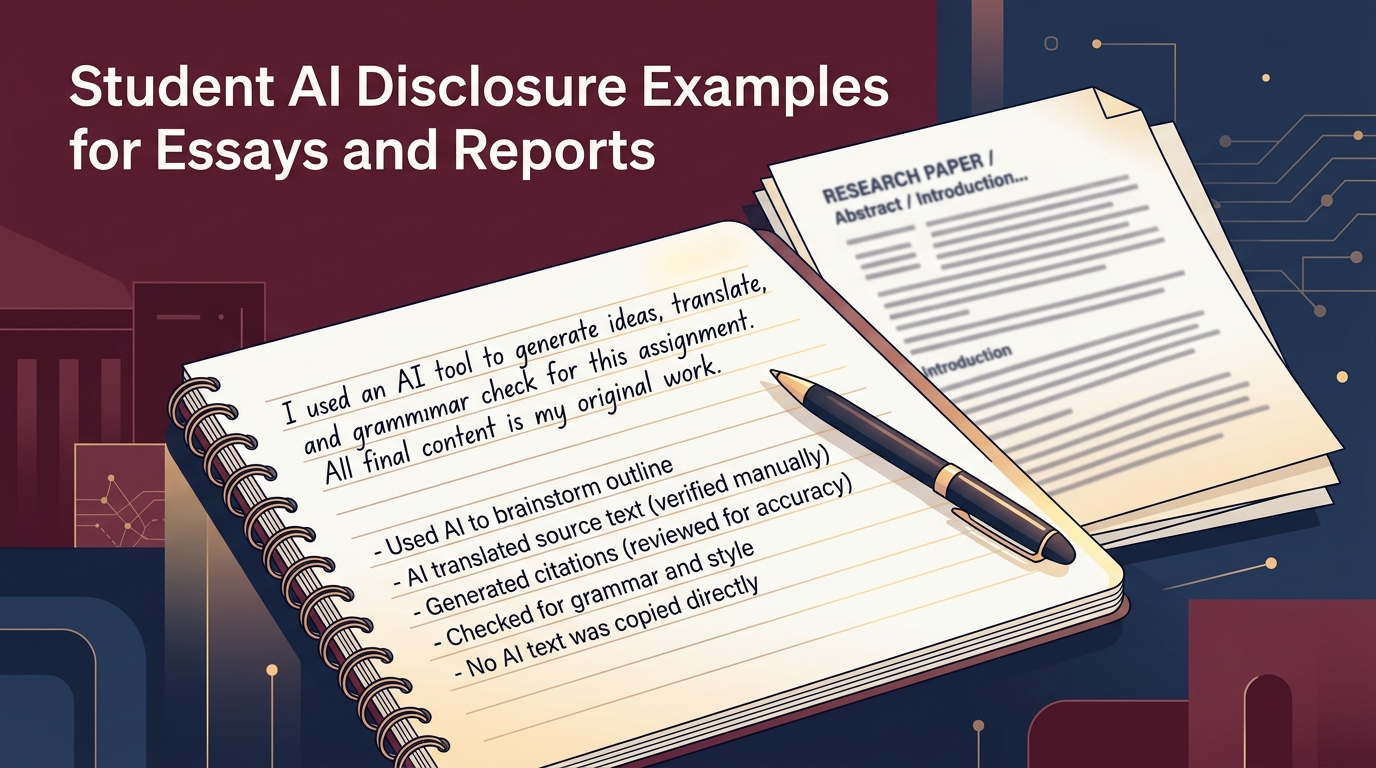
Student AI Disclosure Examples for Essays and Reports
Why disclosure examples help
Many students are willing to follow AI rules but do not know how to describe tool use. Clear examples reduce uncertainty and make AI detection reviews less adversarial.
Use these examples with AI disclosure in academic writing, academic integrity workflows, and 2026 school AI detection guidance.
Example statements
Brainstorming: I used AI to generate possible angles, then selected and developed my own argument. Grammar review: I used AI to identify grammar issues but wrote and revised the final content myself. Citation support: I used AI to format citations, then verified each source manually. Translation support: I used AI to compare phrasing and checked the final wording myself.
What good disclosure includes
A good disclosure states what tool support was used, what task it helped with, and what the student personally verified or revised. It should be short, specific, and attached to the assignment when required.
FAQ
Does every AI use need disclosure?
Not always. The course or organization policy should define the threshold. Low-risk spelling support may be treated differently from generating paragraphs or rewriting the argument.
What makes disclosure trustworthy?
Trustworthy disclosure is specific, concise, and verifiable. It should name the kind of help received and what the student personally checked or revised.
Frequently Asked Questions
Where should I put my AI disclosure statement in an essay?
Place it where your instructor or assignment policy specifies, which is usually a short note at the end of the document, on a cover page, or in a footnote. If no location is given, a brief statement just before the references list keeps it visible without disrupting your argument.
Will disclosing AI use lower my grade?
Disclosure itself is not penalized when the use is allowed under the course policy; it is undisclosed or prohibited use that creates risk. Honest, specific disclosure usually builds trust and makes any AI detection review far less adversarial.
What should I do if I am unsure whether my AI use needs disclosure?
When in doubt, ask your instructor before submitting and disclose the use rather than omit it. A short, specific statement costs nothing and protects you if the threshold for that assignment turns out to be stricter than you expected.
Can I be accused of AI misuse even if I wrote the essay myself?
It is possible, since AI detectors estimate probability and can flag human writing, especially formulaic or heavily edited text. Keeping drafts, outlines, and version history, along with a clear disclosure of any tool support, gives you evidence to explain your process.
Share
Related Posts

Academic Writing
A practical, fair-minded guide to writing classroom AI policy: treat detector scores as signals, protect due process, and build a review workflow students can trust.
Jun 24, 2026

Academic Writing
A practical AI detection policy template covering allowed AI use, disclosure, evidence review, false positives, appeals, and documentation.
May 31, 2026
Academic Writing
A practical checklist for universities designing AI detection policies, disclosure rules, review steps, and student-centered appeals.
May 31, 2026