
Academic Writingpublished on May 31, 2026
AI Detection in US Schools and Universities in 2026
Why 2026 changes the AI detection conversation
AI-assisted writing is now normal in schools and universities. The question is no longer whether students have access to tools. The question is how institutions create fair rules, review evidence, and teach responsible disclosure.
GPTZeroAI recommends pairing AI detector for teachers guidance with a broader academic integrity solution. Detection should identify passages for review, not act as a standalone accusation.
What a school workflow should include
A strong 2026 workflow defines acceptable AI help, collects drafts where possible, checks citations, runs AI detection, and gives students a chance to explain their process. Reviewers should document why a result was escalated, dismissed, or handled through revision.
Policy links that help
Schools can connect this workflow to AI detection in schools 2026, false-positive guidance, and how AI detection works. This gives students and educators a shared language for evidence and uncertainty.
FAQ
Should every assignment be scanned?
Not always. Schools may prioritize high-stakes writing, unexplained style shifts, or assignments where AI disclosure is required.
Can detection prove misconduct?
No. It should trigger review with drafts, citations, student explanation, and policy context.
Frequently Asked Questions
What AI detection score should trigger an academic review?
There is no universal cutoff that proves misconduct, so most institutions treat a high score as one signal among many rather than a threshold. Pair the score with drafts, citation checks, and a student conversation before deciding whether to escalate.
How can students protect themselves against a false positive?
Keeping version history, draft files, and notes makes it easy to show a paper's authentic writing process. Tools like Google Docs revision history or saved outlines give reviewers concrete evidence beyond a single detection result.
Is it legal for US universities to use AI detection on student work in 2026?
Yes, but institutions should disclose detection use in their academic-integrity policy and follow privacy rules like FERPA when handling student submissions. Transparent policies and a documented appeals process reduce both legal and fairness risks.
Do AI detectors work on non-native English writers' assignments?
Detectors can be less reliable on writing by multilingual students because simpler sentence patterns sometimes resemble AI output. This is why human review, drafts, and student context should always accompany any flagged result.
Share
Related Posts

Academic Writing
A practical, fair-minded guide to writing classroom AI policy: treat detector scores as signals, protect due process, and build a review workflow students can trust.
Jun 24, 2026
Academic Writing
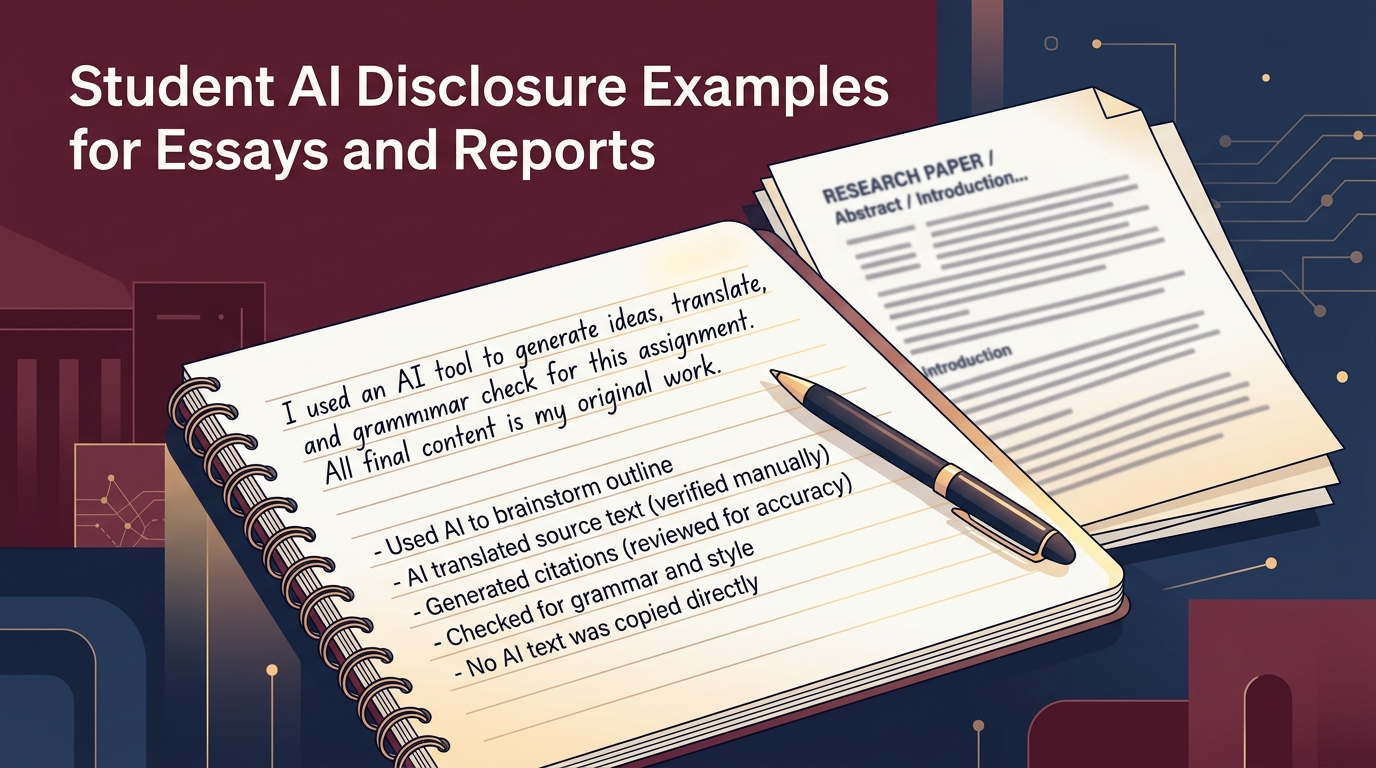
Examples of student AI disclosure statements for brainstorming, outlines, grammar review, translation, citation support, and draft revision.
May 31, 2026
Academic Writing
A practical AI detection policy template covering allowed AI use, disclosure, evidence review, false positives, appeals, and documentation.
May 31, 2026