AI Detectionpublished on Jun 24, 2026
How AI Detectors Work: Perplexity and Burstiness Explained
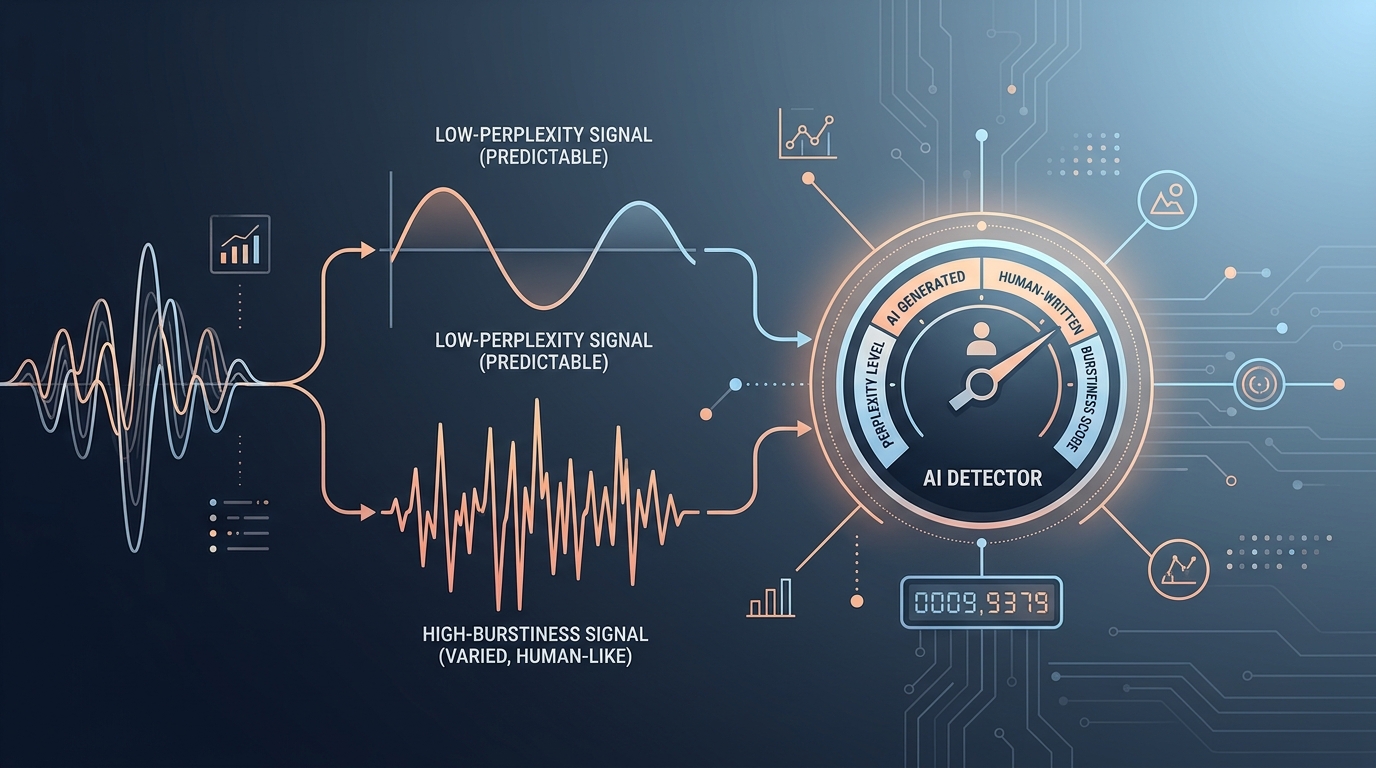
AI detectors do not read meaning the way a person does. Instead, they measure statistical patterns in how words are chosen and arranged. Two of those patterns, perplexity and burstiness, do most of the work. Understanding them helps reviewers read a score as evidence to inspect, not as a final ruling.
What perplexity measures
Perplexity describes how predictable a passage is to a language model. The detector asks, in effect, how surprised a model would be by each next word. When text follows the most likely path again and again, perplexity is low. When word choices are unexpected, idiosyncratic, or uneven, perplexity rises.
This matters because models such as GPT-5, Claude, and Gemini are trained to produce fluent, high-probability text. Their default output is often smooth and confident, which tends to score as low perplexity. Human drafts, by contrast, wander more, leaving a less predictable trail.
What burstiness measures
Burstiness looks at variation across sentences rather than within single word choices. Human writing is naturally uneven: a long, winding sentence may sit beside a short one. Rhythm shifts, complexity rises and falls, and structure varies.
Machine-generated text often holds a steadier cadence, with sentences of similar length and uniform construction. Low burstiness, paired with low perplexity, is a common pattern in AI-assisted drafts. Our methodology page describes how these signals are combined.
Why these signals are not verdicts
Neither measure proves authorship. Several ordinary situations push human writing toward AI-like patterns:
- Translated text often becomes smoother and more uniform than the original.
- Technical or templated writing follows fixed structures that lower burstiness.
- Non-native writing may favor simpler, more predictable phrasing.
- Heavily edited drafts can lose the unevenness that signals a human hand.
Because of these overlaps, a score should narrow where a reviewer looks, not decide the outcome. See our notes on detector accuracy for how confidence shifts with sample length and document type.
How GPTZeroAI applies them
The AI Detector reports passage-level signals alongside an overall estimate, so reviewers can see where predictability and uniformity cluster. Shorter samples carry more uncertainty, so very brief inputs are flagged with caution rather than a firm score. The intent is a transparent review trail, not an accusation.
Using detector signals responsibly
Treat perplexity and burstiness as starting points. Compare flagged passages against drafts, citations, and the author's usual voice. Record the document context, confirm the sample is long enough to judge, and follow up with a conversation when results are ambiguous. A signal earns its value when it leads to a fair, documented next step.
Frequently Asked Questions
What is perplexity in AI detection?
Perplexity measures how predictable a text is to a language model. Lower perplexity means the wording closely follows the most likely path, a pattern common in AI-generated writing.
What does burstiness mean?
Burstiness measures variation in sentence length and structure across a passage. Human writing tends to be uneven, while machine text often holds a steadier, more uniform rhythm.
Can these signals be wrong?
Yes. Translation, templated formats, non-native phrasing, and heavy editing can all make human writing look predictable or uniform, which is why a score is review evidence rather than proof.
Should I act on a single detector score?
No. Use the score to decide where to inspect more closely, then compare passages against drafts, citations, and context before reaching any conclusion.
Share
Related Posts
AI Detection
A fair, factual comparison of how Turnitin and GPTZeroAI approach AI detection, with a focus on workflow, transparency, and evidence reviewers can act on.
Jun 24, 2026
AI Detection
AI-assisted applications are now common. Learn how recruiters can use AI detection as a fair signal in resume and cover letter screening without auto-rejecting candidates.
Jun 24, 2026
AI Detection
ChatGPT, Claude, and Gemini each leave different writing fingerprints. Here is what actually changes detectability, and why no model is reliably invisible.
Jun 24, 2026